
"Marble Funerary Altar of Cominia Tyche" at the Metropolitan Museum of Art
Persephone: The Harvard Undergraduate Classics Research Journal
204 Boylston Hall
Harvard Yard
Cambridge MA 02138
persephoneharvard@gmail.com

More from this issue:
From Vol. 1, No. 2, Spring 2016. By Anne Power, Harvard College
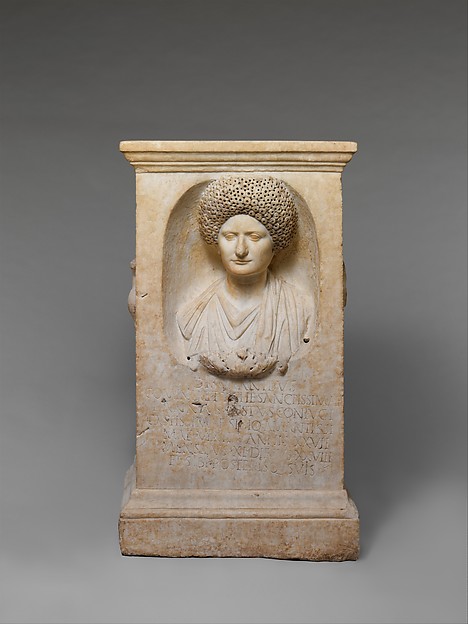 *The image above belongs to the Metropolitan Museum of Art and is reproduced solely to provide context for Power's argument. You can find the link to its website in the bibliography. This funerary altar from the Metropolitan Museum’s collection of Roman Art is dedicated to the memory (and hair) of Cominia Tyche, a Roman woman who died sometime during the Flavian period in the late first century AD[1]. Standing at just over three feet, the altar is rectangular in shape with both the top and bottom bracketed by moldings that lend an architectural, finished quality to the monument. In addition to these ornaments, a niche dominates the front surface of the altar from which a bust of Cominia Tyche herself emerges. She is presented from the chest up, her shoulders draped in finely carved cloth. Her facial features are unique, featuring a large nose, square jaw, and thin lips that create a determined expression. Despite the veristic quality of her depiction, she is still young; her youth may suggest that she died at an early age. Perhaps her most notable feature, however, is her impressive hair, which springs from her forehead in a sizable crescent of tightly wound, equally sized curls. Her hair is so big, in fact, that its upper regions seem ready to break through the topmost limits of the niche and spill over onto the altar beyond. The abruptness of her hairline coupled with the uncanny similarities of each curl suggests that this gravity defying hair style just might be a wig. Below this eye-catching bust is a Latin inscription that tells us both her name and the age at which she died--27 years, 11 months, and 28 days. It also tells us that her husband, Lucius Annius Festus, had this altar set up in her memory. In addition to informing us of her name and age, Festus also uses this inscription to pay homage to Cominia’s good Roman virtues, such as chastity and piety. Indeed, the set up of this monument in the memory of Cominia seems also to be for Faustus’ benefit as he finishes the inscription by mentioning both himself and his descendants.[2] The final element of the altar is around the left corner. Here, the viewer finds a jug and shallow bowl in relief on the side. These objects refer to the common practice of leaving food for the dead at monuments such as this one.[3] It seems as though this altar to Cominia Tyche played several roles in the Roman imagination. At its most fundamental, the monument is meant to commemorate the life and death of a young woman in a permanent medium. On a more materialistic note, the level of detail paid to the bust in addition to the flattering inscription could reflect the importance of display and public image in Roman life. Even in death, Cominia is depicted with an expensive likeness and a fashionable hairstyle, a visual assertion of status that the praise in the inscription is meant to enhance. Not only does the inscription commemorate the chastity and piety of Cominia--important hallmarks of a good Roman matrona--but it also highlights the piety of the dedicator, Lucius Annius Festus. The inscription opens with the lines, “to the spirits of the dead/to the most saintly Cominia Tyche.”[4] This supersession of Cominia in favor of the spirits of the dead reflects the importance of the Roman virtue pietas, both religious and familial. On the one hand, Faustus is expressing his pietas by erecting this monument in the memory of his wife. On the other, he is also using it as a chance to exhibit his reverence and pietas for the dead in general, an important practice for the ancestor-worshipping Romans. This idea of the altar’s double purpose is continued later in the inscription, which ends with the line: “also for himself and for his descendants.”[5] It is clear, then, that this altar not only glorifies the spirits of the dead and of Cominia in particular, but it is also advantageous for Faustus and his family, perhaps as a reminder to contemporary viewers of his munificence and status in life, but also to future viewers of the established lineage of his descendants.The relief of the jug and bowl on the side serve as a reminder that this altar is a monument to Cominia as well as a religious space, a chance for those Romans still living to honor the dead and show off their pietas. Furthermore, when facing the front of the altar the viewer is able to see the raised forms of the jug and bowl on the side. Their depth and discernibility could be read as another indication of the quality of the monument but also as a constant reminder to the viewer of the presence of these objects and the religious rites they imply. The funerary altar of Cominia Tyche and its various elements offer evidence for the prevalent concerns and practices of Roman culture. The high style and fine detail of the bust reflect both Flavian styles and the importance of personal presentation while the inscription reflects anxiety about practicing (and appearing to practice) good Roman virtues. Bibliography The Metropolitan Museum of Art. “Marble funerary altar of Cominia Tyche.” Accessed April 3rd, 2014. http://www.metmuseum.org/Collections/search-the-collections/253569?high=on&rpp=15&pg=1&rndkey=20140331&ft=*&when=A.D.+1-500&what=Sculpture&pos=4
[1] “Marble funerary altar of Cominia Tyche,” accessed April 3rd 2014, http://www.metmuseum.org/Collections/search-the-collections/253569?high….
[2] “Marble funerary altar of Cominia Tyche.”
[3] Ibid.
[4] Ibid.
[5] Ibid.